The Americans Are Not Coming: Why Uganda Won’t Get a Venezuela-Style Intervention
Venezuela vs Uganda: Why Washington Will Move Mountains in Caracas — but Mostly Issue Statements in Kampala By Brilliant Pongo | Opinion for Report Focus News Published: 4 January 2026 A question Ugandans are right to ask In the last few days I’ve been in conversation with a number of colleagues…
Political analyst and media researcher Brilliant Pongo
Venezuela vs Uganda: Why Washington Will Move Mountains in Caracas — but Mostly Issue Statements in Kampala
By Brilliant Pongo | Opinion for Report Focus News
Published: 4 January 2026
A question Ugandans are right to ask
In the last few days I’ve been in conversation with a number of colleagues about Venezuela — and, inevitably, Uganda. The question that keeps coming up from my Ugandan friends is simple, anxious, and painfully familiar:
If President Museveni “wins” the upcoming election and the streets erupt, will the United States intervene the way it has in Venezuela?
It’s an understandable fear — but it’s also a misunderstanding of how power behaves.
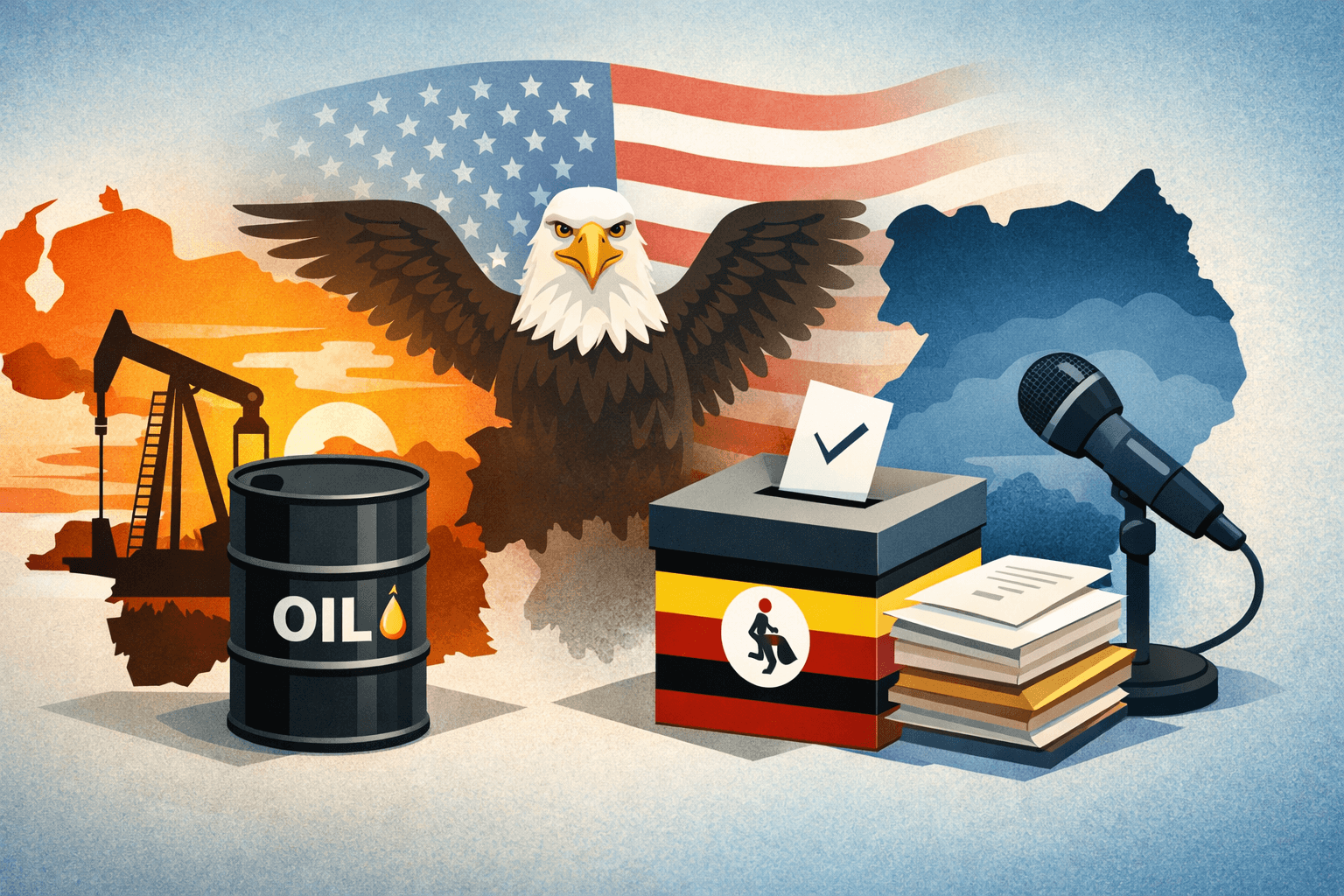
Because what just happened in Venezuela was not a universal “pro-democracy policy” being applied consistently across the world. It was power defending its interests in a place it has historically treated as its strategic backyard — and doing so at breathtaking speed and scale.
On 3 January 2026, U.S. forces captured Venezuelan President Nicolás Maduro and his wife in a military operation and transported Maduro to the United States to face charges that include drug- and weapons-related allegations, among others. That is not a small diplomatic move. That is regime-level force — and the world heard the message loud and clear.
So let’s deal with the Ugandan question honestly.
Geography is not just a map — it’s a doctrine
Venezuela sits in the Americas, inside a region the U.S. has historically treated as a strategic sphere of influence. Whether people want to call it “Monroe Doctrine thinking” or simply imperial reflex, the pattern is old: when Washington acts aggressively, it does so fastest and hardest in spaces it believes it can dominate logistically, politically, and militarily.
Uganda is not in that space.
Uganda is thousands of miles away, in a region where interventions are expensive, complicated, and politically messy — and where outcomes are far less controllable. An American operation in Uganda would not be a quick raid with nearby basing, short supply lines, and near-immediate leverage. It becomes a long entanglement — and Washington, regardless of who is in power, usually prefers cheaper tools when the stakes don’t justify the cost.
Venezuela’s oil: the incentive nobody admits first
We shouldn’t pretend the politics of Venezuela can be separated from petroleum.
Venezuela holds the world’s largest proven oil reserves — commonly estimated around 300+ billion barrels — and its crude is particularly relevant to certain refinery configurations. And the post-capture messaging has been revealing: reports describe U.S. plans to reshape oil flows, ease certain sanctions, and position American refiners and companies to benefit from Venezuela’s heavy crude supply.
Even the public narrative around “temporary control” has been linked to restoring and running Venezuela’s oil sector.
Now compare that to Uganda.
Uganda does have oil — substantial resources in the Lake Albert region — and major projects like Tilenga/Kingfisher and the East African Crude Oil Pipeline (EACOP) are central to that plan. But Uganda’s oil story is not the same as Venezuela’s in three key ways:
Scale and global leverage: Uganda’s reserves and output potential matter — but they don’t rewire global flows the way Venezuela can.
Existing project structure: Much of Uganda’s oil development is already tied to specific corporate and regional arrangements.
Cost-benefit for Washington: The U.S. can pressure Uganda without “owning” Uganda — and that is usually the preferred method when the prize isn’t massive enough to justify military and diplomatic blowback.
So yes: resources matter, but not all resources trigger the same appetite. Venezuela’s oil has a different gravitational pull.
Power first, paperwork after: the “legal” story
The U.S. claims legal justification for the Maduro capture by pointing to indictments and national security interests — but legal experts have publicly disputed the coherence of that rationale under international law, particularly without UN authorization or congressional approval.
The point isn’t a courtroom debate. The point is this: when the U.S. decides it wants you, it will find a narrative that fits.
This is why anyone framing Venezuela as a “human rights rescue mission” is either naïve or performing.
Yes, Maduro has faced U.S. allegations for years — including a major DOJ announcement in March 2020 charging Maduro and others with narco-terrorism, corruption, and drug trafficking claims. But the leap from indictment to military capture of a sitting head of state is not “routine law enforcement.” It is power.
Uganda’s general election is scheduled for 15 January 2026, per Uganda’s Electoral Commission timetable. Bobi Wine has been cleared to run again against President Museveni.
But here is where experience matters: even when observer missions raise concerns, outcomes often stand — especially where incumbency is deeply entrenched and security institutions remain loyal.
Uganda has seen this movie before. And in previous cycles, even key international actors have sometimes stepped back: in 2021, for example, the U.S. cancelled its observation effort citing restrictions and lack of robust participation by observers.
So what does Uganda realistically get in 2026?
Statements urging calm
Warnings about rights and process
Targeted visa restrictions or sanctions on individuals if violence is extreme
A familiar diplomatic “acceptance” of the declared outcome, dressed in cautious language
That’s not cynicism. It’s the pattern of low-cost engagement.
Even U.S. analysts have been noting a constrained U.S. engagement posture as Uganda approaches this election cycle, despite ongoing concerns about authoritarian consolidation. And a U.S. Congressional Research Service report flags the January 2026 election context while mapping a relationship shaped by security interests and governance concerns — meaning Washington has tools short of intervention that it prefers to use.
The AU and regional leaders: silence as a strategy
My Ugandan colleagues keep asking, “Where is the AU?” That question carries disappointment — but it also reveals the false hope many people still place in continental bodies that are structurally allergic to confronting sitting incumbents.
The African Union’s culture is heavily shaped by state sovereignty norms and elite solidarity. Regional leaders often avoid setting precedents that could later be used against them. So when the opposition cries foul, the response is frequently muted: dialogue language, peace language, stability language — and not much else.
The tragedy is that this silence becomes its own kind of endorsement.
Bobi Wine’s restraint — and the trap it can become
Whatever one thinks of Bobi Wine politically, it is worth acknowledging something important: calls for calm and restraint can prevent bloodshed. In a country where state force has historically not hesitated to respond harshly, disciplined messaging matters.
But we must be honest about the cost: restraint can also become a trap, where the opposition is praised for peace — while the system remains unchanged.
Uganda’s youth deserve better than being told to “be peaceful” while they watch the same political loop repeat.
The hard conclusion: Uganda will not be “rescued”
So to my Ugandan friends, I say this with no pleasure: the Americans are not coming.
Not with helicopters. Not with special forces. Not with regime-change theatre.
What may come are statements, sanctions, visa bans, and concerned diplomacy. But if you are waiting for Venezuela-style intervention, you may wait until your hair turns grey.
And to Museveni: Venezuela is not your template. The U.S. did what it did there because the incentives were aligned — geography, doctrine, and oil leverage — and because Washington believed it could dominate the outcome. Uganda is a different calculation.
If change comes, it is more likely to come through internal fractures, elite bargaining, party succession wars, or pressure that reshapes the ruling coalition over time — not a foreign rescue mission. That is the bitter truth many nations learn too late:
No one is coming to save you. A country heals from within — or it keeps bleeding in cycles.
And yes, the most realistic political shift may ultimately emerge from within the ruling system itself, whether through succession struggles, generational pressure, or internal reform currents — not because it is morally ideal, but because that is how entrenched systems usually change when external actors refuse to pay the price of disrupting them.
Uganda should prepare for peace — but also prepare for realism. Because in global politics, morality is often the costume. Interests are the body underneath.