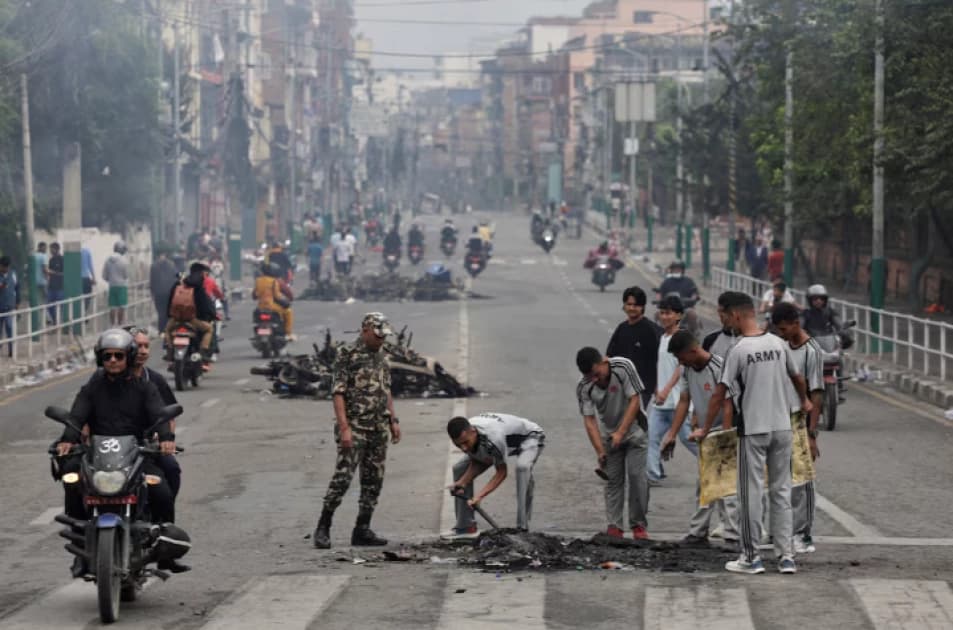
Nepal's army resumed talks Thursday with youth protesters to select an interim leader after demonstrations killed 30 people and forced Prime Minister KP Sharma Oli to resign, an army spokesperson said.
Soldiers patrolled quiet streets in Kathmandu following the worst unrest in years. The protests began as opposition to a social media ban but escalated into broader anti-corruption demonstrations.
"Initial talks are ongoing and would continue today," army spokesperson Raja Ram Basnet told Reuters. "We are trying to normalize the situation slowly."
The death toll rose to 30 on Wednesday, according to the health ministry. More than 1,000 people were injured when security forces used live ammunition against crowds Monday.
Gen Z protesters, aged 13 to 28, led demonstrations that torched parliament, the Supreme Court and government offices Tuesday. Protesters also attacked homes of political leaders.
Oli resigned Tuesday citing "the extraordinary situation" after the army advised him to step down. The 73-year-old had served his fourth term as prime minister since July 2024.
President Ramchandra Paudel called for dialogue with youth groups. More than 3,200 protesters discussed demands on Discord including parliament dissolution and elections within six months.
"The voices of young Nepalis have been heard loud and clear," the UN Country Team said in a statement Wednesday.
Former chief justice Sushila Karki emerged as the protesters' preferred candidate for interim leader. Nepal Bar Association confirmed her willingness to accept the role.
The army deployed troops nationwide Tuesday night, establishing checkpoints and imposing movement restrictions. Tribhuvan International Airport reopened Wednesday after a 24-hour closure.
The government lifted its ban on Facebook, Instagram, WhatsApp and YouTube that triggered initial protests September 4. Authorities had blocked 26 platforms for failing to register locally.
Youth unemployment stands at 20.8 percent, forcing thousands to seek work abroad daily. Remittances comprise 33.1 percent of GDP, according to World Bank data.
Police recovered 73 firearms looted during unrest. More than 13,500 prisoners escaped nationwide, with 303 recaptured by soldiers.
UN High Commissioner for Human Rights Volker Turk called for investigation into security force actions. Civil society groups condemned the "excessive use of force" against peaceful protesters.
The unrest marks Nepal's biggest crisis since its 2006 civil war ended. The country has had 14 prime ministers since establishing a republic in 2008.